
Leave Your Message
In the era of smart manufacturing, the integration of vision sensors for robot-guided positioning has emerged as the cornerstone of flexible automation. Traditional robotic arms operated blindly, relying on rigid mechanical fixtures and static pre-programmed coordinates. This approach lacked adaptability, resulting in high retooling costs and vulnerability to component alignment variations.
By equipping industrial robots with advanced vision sensors and high-resolution telecentric optical systems, systems can now dynamically "see" and interpret their physical workspace. This technological evolution allows robotic systems to identify target objects in real-time, compute precise spatial coordinates, and execute intricate pick-and-place, assembly, or inspection tasks with sub-micron accuracy.
Eliminates the need for expensive mechanical jigs and fixtures, easing product changeovers.
High-performance telecentric lenses eliminate distortion and parallax errors.
Optimizes robotic path planning dynamically, reducing cycle times significantly.
High-resolution optical components designed to deliver ultra-precise spatial imaging for robotic alignment systems.


How vision-guided positioning is transforming global manufacturing standards and driving operational efficiency.
While 2D vision sensors remain standard for planar tasks, the industry is witnessing a rapid transition to 3D vision systems. Utilizing structured light, stereo vision, and Time-of-Flight (ToF) technologies, modern robots can determine depth and orientation, enabling the precise picking of randomly stacked parts from deep bins.
Integrating artificial intelligence and deep learning algorithms directly into vision sensors allows real-time classification, localization, and pose estimation. This edge computing approach minimizes network latency, allowing robots to make instantaneous trajectory corrections.
High-speed industrial processes require a seamless synergy between high-resolution image sensors and optical systems. Telecentric lenses are crucial here, ensuring that perspective error is eliminated, which maintains spatial coordinate accuracy even during object height variations.
Analyzing the critical role of vision-guided robot positioning across demanding industrial sectors.
In the semiconductor industry, components are miniaturized to the micro-scale. Traditional mechanical positioning is insufficient. Vision sensors paired with bi-telecentric lenses are deployed to identify sub-micron fiducial marks on wafers and substrates.
The system calculates rotational and translational deviations (X, Y, Theta offsets) in milliseconds, allowing the robotic manipulator to place dies with extreme precision. This eliminates component damage and guarantees high yield rates in cleanroom environments.
Automotive manufacturing demands both heavy-duty capability and fine precision. Vision sensors guide robotic arms during critical assembly processes such as windshield insertion, door hanging, and spot welding.
By scanning the car chassis dynamically on the assembly line, the vision sensor compensates for any variance in conveyor positioning, ensuring that the robotic arm applies welds or mounts parts exactly where specified, preventing structural inconsistencies.
In logistics centers and smart warehouses, robots handle packages of unpredictable shapes, sizes, and orientations. A vision sensor mounted on the robotic arm scans the bin, creates a 3D point cloud, and calculates the optimal gripping path.
This eliminates the need for manual sorting, ensuring continuous, high-speed depalletizing and sorting operations that can run 24/7 with zero human intervention.
Medical devices and pharmaceutical products require sterile, zero-defect production. Vision-guided robots ensure that delicate medical components are assembled, sealed, and packaged without contamination.
Simultaneously, the vision sensor performs real-time inspection, checking for dimensional accuracy and surface defects, ensuring only qualified products proceed to packaging.
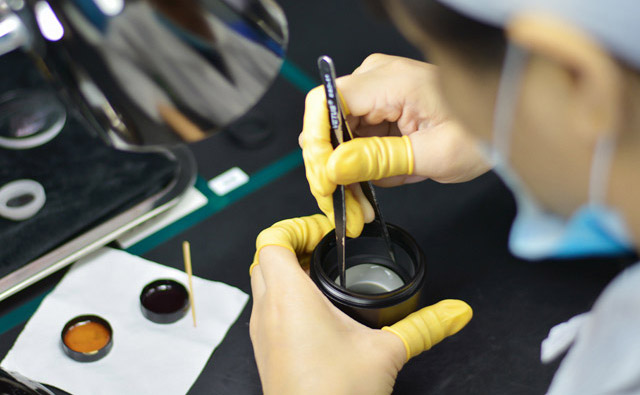
Canrill Quality Management System conforms to the standard of ISO9001:2015 in the production of industrial telecentric lens and accessory. Our Quality Dept consists of 13 experienced persons, representing more than 13% of the total personnel in Canrill, showing the immense importance of quality in Canrill’s whole system.
Our Quality Department has four specialized branches working independently to ensure the exceptional performance of each telecentric lens: IQC (Incoming Quality Control), IPQC (Input Process Quality Control), QA (Quality Assurance), and OQC (Outgoing Quality Control).
Appearance (no scratches, aberration, white dot or dust), lens cone gap less than 0.1mm, no loose parts, sticker on both lens & box, accessory, desiccant, certificate of qualification, coaxial light.
Verifying model name and quantity match specifications exactly.
Comprehensive inspection of appearance, specification tolerance, oxidation, and materials.
Differentiate qualified from unqualified, model name & quantity, in good package.
BOM list verification, perfect appearance checking, assembly according to drawings strictly, no missing screws, no missing glue.
Verification of quantity, appearance, sticker, accessory, and box integrity.
Ensuring clear images, no angle ambiguity, precise working distance, telecentricity, and minimal distortion for high-accuracy positioning.
Explore our full range of high-resolution, low-distortion telecentric lenses designed to optimize robot-guided positioning systems.


Understanding the optical physics that enable high-precision robot-guided positioning.
Standard optical lenses suffer from perspective (parallax) error: objects appear larger when they are closer to the lens and smaller when they are further away. In robotic positioning applications, any slight variation in component height or distance from the sensor will result in inaccurate measurement calculations.
Bi-telecentric lenses solve this problem by ensuring that light rays enter and exit the lens parallel to the optical axis. This maintains a constant magnification across the entire depth of field, ensuring that the vision sensor measures the target object's spatial coordinates accurately, regardless of working distance variations.
Geometric distortion in standard lenses bends straight lines, making precise coordinate mapping difficult. Software correction can compensate for this, but it introduces computational overhead and can degrade image resolution at the edges.
Canrill's telecentric lenses are engineered to achieve near-zero distortion. This optical correction ensures that the vision sensor captures a geometrically accurate representation of the workspace, allowing the robotic positioning system to calculate coordinates directly without complex software correction.