
Leave Your Message
In the era of Industry 4.0, the "Lighting Machine for Robot-Guided Positioning" has transitioned from a basic peripheral to the absolute cornerstone of autonomous manufacturing. Modern industrial robots are no longer just blind executors of pre-programmed paths; they are intelligent entities that perceive their environment through sophisticated machine vision systems. The global market for robot-guided vision is experiencing an unprecedented surge, driven by the demand for micron-level precision in semiconductor fabrication, automotive assembly, and consumer electronics.
Current industrial trends show a shift toward 3D vision and multi-spectral lighting. While 2D vision was sufficient for simple pick-and-place tasks, today’s robot-guided positioning requires depth perception and the ability to distinguish materials under challenging conditions. Integrated lighting solutions, which combine high-power LED arrays with telecentric lenses, ensure that light hits the target at a constant angle, eliminating parallax errors that typically plague standard lenses.
In the semiconductor industry, positioning is measured in nanometers. A lighting machine equipped with 151MP high-resolution line scan lenses allows robots to detect microscopic defects and align wafers during the lithography process. The telecentric nature of the optics ensures that even if the wafer height varies slightly, the magnification remains constant, preventing costly alignment errors.
The rise of electric vehicles has introduced complex assembly tasks involving reflective metallic surfaces. Robot-guided positioning systems must navigate the glare of battery casings. Specialized lighting machines using coaxial or dome illumination, paired with high-performance telecentric lenses, provide uniform light distribution, allowing the robot to precisely weld terminals and place cells without being blinded by reflections.
In massive distribution centers, robots must identify and sort thousands of packages per hour. Here, the "12K Line Scan" technology becomes vital. It allows for continuous imaging of moving objects on a conveyor belt, providing the robot with real-time coordinates for high-speed picking. This integration reduces cycle times and significantly increases throughput compared to manual sorting.
The future of lighting machines for robot positioning is inextricably linked with Artificial Intelligence and Edge Computing. We are moving toward "Smart Lighting" where the illumination parameters adjust dynamically based on the material detected by the sensor. For instance, if a robot detects a matte plastic part followed by a glossy chrome part, the lighting machine will instantly adjust its intensity and angle to maintain optimal contrast.
Furthermore, the integration of 5G technology allows these vision systems to stream high-resolution data to centralized servers for real-time quality analytics, creating a closed-loop system where the robot learns to improve its positioning accuracy over time through machine learning.
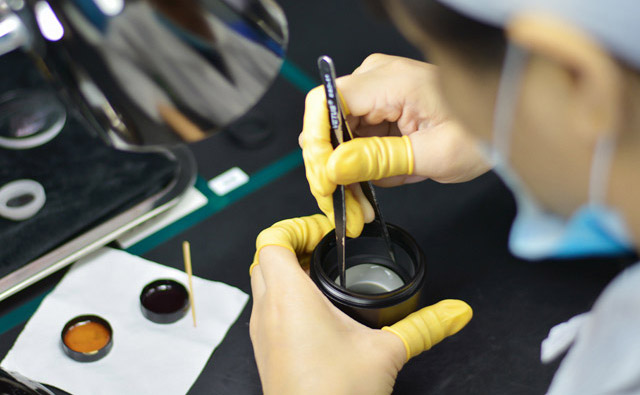
Canrill Quality Management System confirms to the standard of ISO9001:2015 in the production of industrial telecentric lens and accessory. Our Quality Dept consists of 13 experienced persons, more than 13% share of the total personnel in Canrill, showing the importance of quality in Canrill’s whole system.
Quality Dept has four branches, IQC (Income Quality Control), IPQC (Input Process Quality Control), QA (Quality Assurance ), OQC (Outgoing Quality Control). Each branch works independently to make sure the excellent performance of telecentric lens.
In robot-guided positioning, the lens is the interface between the physical world and the digital brain. Standard lenses suffer from perspective error—objects appear larger when they are closer to the lens. For a robot trying to calculate the exact X, Y, and Z coordinates of a part, this perspective distortion can lead to errors of several millimeters.
Telecentric lenses solve this by having a constant magnification regardless of the object's distance within the depth of field. This means the Lighting Machine for Robot-Guided Positioning provides a perfectly orthogonal view of the target. Whether the part is slightly higher or lower on a tray, the robot receives the same precise dimensions, ensuring a perfect "grab" every time. This is critical in applications like PCB component placement (SMT) where components are tiny and the margin for error is non-existent.
 Precision Positioning: 12K Line Scan Telecentric Lens - 151MP High-Resolution