
Leave Your Message
In the modern automotive industry, the transition toward Electric Vehicles (EV) and Autonomous Driving (AD) has pushed manufacturing tolerances to unprecedented levels. Industrial lenses for automotive parts gauging have evolved from simple inspection tools into critical components of the "Zero-Defect" production philosophy. Today, Tier 1 and Tier 2 suppliers require measurement systems that can handle complex geometries with sub-micron accuracy.
The current industrial landscape is characterized by a shift from manual sampling to 100% automated inline inspection. As automotive components become more integrated—such as the complex cooling plates in EV batteries or the intricate sensors in ADAS systems—the demand for high-resolution, low-distortion telecentric lenses has skyrocketed. These lenses eliminate parallax error, ensuring that a part's dimensions are measured accurately regardless of its distance from the lens, a feature that is non-negotiable in precision gauging.
Meeting the rigorous standards of IATF 16949 requires measurement systems that provide repeatable, verifiable data across millions of cycles.
Inspecting battery tab welds and cell alignment requires specialized optics that can detect minute defects in high-speed production lines.
Modern industrial lenses are now designed to work seamlessly with AI-driven software, providing the high-contrast imagery needed for deep learning algorithms.
The rise of electric mobility has introduced new challenges. Telecentric lenses are used to measure the flatness of battery housing and the precise positioning of connector pins. Even a 0.1mm deviation in a battery busbar can lead to thermal runaway risks. Our lenses provide the depth of field and resolution required to gauge these components in 3D space with absolute certainty.
Safety-critical parts like ABS valves, brake pistons, and airbag initiators require 100% inspection. Gauging these parts involves measuring diameters, thread pitches, and surface finishes. Industrial lenses with high magnification and low distortion allow vision systems to detect microscopic burrs or cracks that could compromise safety.
For Internal Combustion Engine (ICE) components, gauging remains vital for fuel efficiency. Measuring valve stem diameters and fuel injector nozzles requires lenses that can operate in harsh industrial environments while maintaining optical stability. Telecentricity ensures that the circularity of a bore is measured without perspective distortion.
As cars become "computers on wheels," the number of electronic connectors has increased. Gauging the coplanarity of pins and the alignment of CMOS sensors in cameras is a high-speed task that demands the best in machine vision optics. High-resolution bi-telecentric lenses are the gold standard here, providing clear edges for edge-detection algorithms.
The future of automotive parts gauging is moving toward "Smart Optics." We are seeing several key trends:
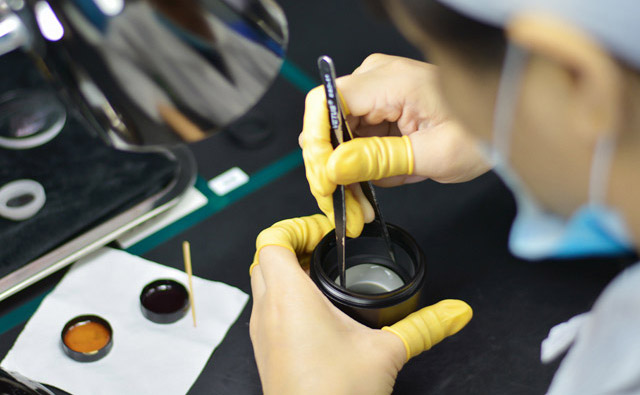
Canrill Quality Management System confirms to the standard of ISO9001:2015 in the production of industrial telecentric lens and accessory. Our commitment to quality ensures that every lens used in automotive gauging meets the strictest performance metrics.
Our Quality Dept consists of 13 experienced persons, more than 13% share of the total personnel in Canrill, showing the importance of quality in Canrill’s whole system.
Quality Dept has four branches: IQC (Income Quality Control), IPQC (Input Process Quality Control), QA (Quality Assurance), and OQC (Outgoing Quality Control). Each branch works independently to make sure the excellent performance of telecentric lens.
 China 5MDT Series Bi-Telecentric Lenses for 2/3 Sensors
 Bi-Telecentric Lenses for 1.1 Sensor - 0.209X to 1.5X
China 5MDT Series Bi-Telecentric Lenses for Semiconductor Applications
 China Telecentric Lens MT Series - High Precision Bi-Telecentric
5MDT Series Bi-Telecentric Lenses for 2/3 Inch Sensors
1.1-Inch Sensor MDT Series: Bi-Telecentric Lenses from China
China 5MDT Series Bi-Telecentric Lenses - Factory Direct
10MDT Series Bi-Telecentric Lenses for 1.1' Sensors - Top China
In the world of industrial lenses for automotive parts gauging, the term "telecentric" is more than just a buzzword; it is a fundamental requirement for accuracy. Conventional lenses have an angular field of view, which creates perspective error—often called parallax. As an object moves further from the lens, it appears smaller. In a gauging application, if a mechanical part vibrates or is slightly displaced on a conveyor belt, a conventional lens would report an incorrect measurement.
Bi-telecentric lenses, like our 5MDT and 10MDT series, solve this by keeping the principal rays parallel to the optical axis on both the object and image sides. This means the magnification remains constant regardless of the part's position within the depth of field. For automotive components like cylinder heads or complex gear assemblies, this ensures that the edges are always viewed from a perfectly perpendicular perspective, resulting in measurement data that is repeatable and reliable. Furthermore, our lenses are designed with extremely low distortion (often
When selecting a lens for automotive gauging, engineers must consider the "Working Distance" and the "Field of View." Our MT Series offers a variety of magnifications from 0.209X to 1.5X, allowing for the inspection of both tiny electronic components and larger mechanical housings. The ability to resolve fine details—measured in microns—is what separates a standard industrial lens from a high-performance gauging lens. By investing in superior optics, automotive manufacturers can reduce waste, prevent costly recalls, and maintain their competitive edge in an increasingly automated world.
In conclusion, as the automotive sector continues to innovate, the role of vision-based gauging will only grow. From the initial inspection of raw materials to the final assembly of complex EV drive units, industrial lenses serve as the "eyes" of the factory. Our commitment to ISO9001 standards and our rigorous 7-step quality control process ensures that every lens we ship is ready to perform in the most demanding automotive environments.